Next MatchAFC Westend (Sunday) – Parkside Sunday/04/10/2026/WESTEND SPORTS & SOCIAL CLUB



As long ago as 975 a large part of Esher was in the hands of the church. Bishop Erkenwald granted five mansas of land in Esher to Chertsey Abbey.
Confirmed in 1062 by King Edward, the village of West End would only have been a few cottages and huts belonging to the agricultural villeins bound to the land.
The first mention of a farm was in 1526, when Garsons Farm was referred to as “Gastunfeld,” it was farmed in 1780 by William Nightingale, together with Walton Farm known as Winterhouse Farm, which dates back to Tudor times; in 1548 it was known as “Wynterhous”. It was much larger in the 17th Century when it was farmed by Thos. Awbrooke. It stretched as far as Stoney Hills, one field was known as Highfield which is the name of a house where a Mrs. Butler and her husband lived.
When Clive of India rebuilt Claremont he altered part of the Portsmouth Road. The grounds reconstructed by Capability Brown, were not large enough so the Portsmouth Road was altered from its former position through Claremont to its present position. Horseshoe Clump Hill was cut through and the mound of earth from the excavations is the present Horseshoe Clump. It was known at the time as the “New Cut Hill”.
From a small hamlet of labourers’ cottages over the years, the village of West End slowly emerged. Lord Tyrconnel, one of the former owners of Claremont, built West End Cottage for his mistress Sarah Thompson, (a nice lady, the villagers said).
The house, later called The Cedars, stood where West End Gardens is now situated. It was a gracious house, with large glass windows to catch all the sun. Later in 1836-1839 William and Mary Howitt the Quaker writers, lived there and described the villagers as “ignorant and improvident, but affluent in owning a cottage, a pig, a garden, and a large flock of geese which they graze under common rights on the common. Most have a cow and often a pony, they are all employed and ask a great price for mushrooms, fruit, geese, whatever they sell.”
She also mentions that you could walk for miles through pinewoods and heath and not meet a soul. Charles Dickens visited the Howitts at West End and their pony, owned by Lord Tyrconnel, appears as “Peg” in Master Humphries Clock.
The Howitts later moved to “The Orchard” which belonged to Florence Nightingale. The Cedars, which had a ghost of a grey lady, was demolished in the 1930s for modern houses. Opposite lies West End Lodge, where Mr. Nat. Petree lived. When he died he left (in 1879), £850 to the rector for support of the Sunday School and a library of religious books and £1,000, the interest to be paid to the schoolmaster to act as librarian.
Another interesting house, once Hodgsons Inn, the Chequers, was the haunt of Jerry Abershaw, a young Highwayman who robbed (very courteously) mail coaches in Surrey. There is said to be a tunnel from the inn under the common to the Portsmouth Road, any hint of the law arriving and Jerry and his chestnut mare were away down the tunnel. The landlord was in on the nefarious goings on and used to offer the coach drivers a pinch of snuff with an opiate in it, so that sleep overcame them further on and Jerry was waiting.
Later, stage folk rented The Cottage—Carl Brisson, Gwen Farrar and Norah Blaney.
Claremont Cottage is another interesting house. A Mrs. Brough—wife of a Claremont Bailiff—went off her head and chopped up her children, and then waved the bloodied sheets out of the window, screaming madly until she was removed. She is said to haunt and wave the sheets, but the present owners have not seen her yet.
In 1857 a Mr. Turner, who stopped at The Brown Bear in Esher, walked down to West End and did not think much of it, as he described it as “a nasty, stinking and choleric locality, compelling me to be constantly sniffing at my camphor, to get a view of a house where a terrible murder had been committed a few months previously.”
Two small cottages known as Alder’s Cottages (now Clover Cottage) have been converted into one, they were built by Thos. Alder, a popular butcher in the 19th Century. He was a friend of George Meredith and a regular follower of the Duc D’Aumerles hounds. The French Royal family lived at Claremont at this time.
Opposite Alder’s Cottage was a similar wooden boarded cottage, now demolished for modern houses. By the 19th Century the village had grown considerably. There was a Post Office on the corner, later run by a Mr. and Mrs. Webb. This has been demolished for a modern house.
Albany Lodge, which still has the Royal Arms on the front, was the home of Dr. and Mrs. Royle, he was a physician to the Duchess of Albany, his daughter Mrs. Haughton and her family lived in it in the ‘30s.
Glenhurst later called Talbot Lodge, now demolished, was the home of Col. and Lady Emma Talbot. She was Lord Derby’s daughter, and she had been bridesmaid to Queen Victoria’s eldest daughter. Col the Hon. Sir W.P. Talbot had been for 40 years Sgt. at Arms of the House of Lords. They were very well liked in Esher.
During the 19th Century, the Prince of Wales public house was built. It used to be a quiet village inn which we used to visit when we were skating on the pond. It has been enlarged. Next to it is the tall tower of the old Hodgson’s Brewery, later used by Mr. Plowman as a boot repairer’s and saddler’s shop.
Ponds
Both the ponds and the ditches on the common have been wrongly used. The larger pond (Prince of Wales) used to be twice the size, it was used for drinking by the cows at Chamber’s Farm, now a close of houses. The pond nearly reached the road and has now been suburbanised into a smaller edition. The Chequers Pond was a very large pond on which we used to skate. It was allowed to become overgrown and silted up, although efforts have been made to clear it. The large ditch with a pipe in it has been filled in and the ditches each side of the main path on the common have also silted up. These were dug by the Canadians in the First World War to allow them passage to the gun emplacement, which are still on the common under the brambles etc., and Horseshoe Clump is still full of spent bullets where the rifle range was situated. It is not surprising that West End was so badly flooded some years ago as all the natural outlets for flood water were blocked up or altered.
The infants’ school was built in 1879 by Mrs. Bailey of Highfield, Stoney Hills, in memory of her husband. The little church St. George’s, West End, was always known as the “Tin Chapel”, but was really a Chapel of Ease.
The character of West End has changed almost beyond recognition since the Second World War, I remember when it was almost all village people. Some had been there for years, The Flippances, Plowmans, Nightingales, Lynn the Butcher, Fosters, Thompson, Lady Emma Talbot, Miss Talbot, who did such a lot of charity work for the village.
The Chequers was always favoured by stage folk. Gwen Farrar and Norah Blaney, cabaret artistes of the 1930’s owned it for a time, and also Carl Brisson, a matinee idol, lived there. The Old Nurseries was modernised and Pamela Wynne, a well-known novelist, bought it and lived there.
What is now Noel Cottage was the stables and apple loft to the Griffiths’ house Hillside. One of the most interesting residents was the Hon. Mrs. Victor Bruce, a small lady who did big things. She held many world records for motoring, travelled farthest north into Lapland, was awarded the women’s trophy in 1927 in the Monte Carlo Rally and broke flying records. In fact she was one of the founders of Imperial Airways. She was a Fellow of the Ancient Monuments Society and in 1939 was awarded the French Indo-China Order for the Million White Elephants and White Umbrellas.
She took later to show jumping, and in addition to all this she wrote several books. She lived with her son Tony at The Woodbines, now Pickenham. Abraham Sofaer later lived there.
Tunnel?
The fields at Hawkshill where once we used to toboggan, have been built over and there has been a great deal of infilling in the gardens of the larger houses, some of which are demolished. The Recreation Grounds were fields owned by Mr. Bob Timmis, who allowed us to keep a boat there. We used to swim a lot in the Mole.
During Queen Victoria’s time at Claremont, Mr. Williamson (her favourite sculptor’s son) got up early one morning to meet a friend for a swim. He swam into a tangle of weeds and drowned. At one time there was a stone which Mr. Williamson sculpted arid had erected on the bank opposite the place where his son drowned, which bore the words “Take heed to thy ways”.
I think it probably vanished when Esher Place was developed into a housing estate. A great deal of excitement and interest was shown when the owners of the Chequers found what appeared to be the entrance to a tunnel in the house.
It was thought at first that this was the secret way out to the Portsmouth Road that Jerry Abershaw used to escape from the law, but it turned out to be a large oven used, as the house was an inn, for baking a large quantity of bread!
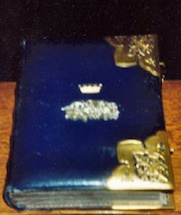
The little Chapel of Ease was often attended by the Duchess of Albany, who used to walk from Claremont to worship there.
*She left her Bible there, but it has vanished. It was used at her wedding, and should have been preserved as an Esher relic.
The Holy Bible was presented to St. George’s Church, West End, by The Duchess of Albany in 1916 following the death of her husband, Leopold.
Miss Marian Barker, a late well-known member of an Esher family and whose brother was Reader to the Duchess of Albany, lived at The Cedars, told an interesting story about the house. It belonged to the Verney family. Mrs. Verney’s mother was an Indian Begum, and the house had large glass windows built on so that all got the full benefit of the sun.
There was a tablet on the wall of the house mentioning the fact that the writers and reformers Mary and William Howitt had lived and worked there, but the tablet was lost in the demolition of the house. Under the huge parasol-like cedar tree a ghost of a grey lady was supposed to haunt, but she has quite probably taken a look at West End today, and emigrated!
Brewery
It is astonishing that for so small a place as West End attracted a star-studded collection of notabilities over the years. One of the most interesting was William Duckett, who in the 18th Century, farmed South Weylands farm. He was first employed by the Duke of Newcastle in the gardens of Claremont. He also farmed Sandown Farm for Francis Pelham, who owned both farms. He invented a drill-plough for which he received the prize of a silver cup, presented to him by the Marquis George for his interest in agriculture, used to visit Weylands Farm, The King sent William Duckett’s son John, to the Cape of Good Hope, with staff, to introduce his father’s new farming methods. He died, at the rather early age of 53, of a fever, but there is a memorial to him engraved on the family tomb in St. George’s churchyard, where his parents and his brother Mark, are buried.
The Prince of Wales public house was built, a really rural pub. Until the First World War, there was a brewery attached which later became Mr. Frank Plowman’s boot and saddlery repair shop. In 1870 a cricket club was formed, which played on the common.
The editors of Punch, Tom Taylor and Sir F.C. Burnand, had a cottage just past the Mole Bridge.
A fair amount of building had taken place during the 19th Century, and the early part of the 20th Century. There were small shops and a blacksmith’s next door to The Chequers.
As the village grew the commoners who had rights to graze on various pieces of ground, including the common, were allowed to start their allotments at the bottom of More Lane in Sandown, and a special plot was leased to the West End villagers. Same of the allotments are still in use today.
– Reprinted with the kind permission of Miss Irene Codd who lived in her family home, Grapes House, Esher, for most of her life.